

Summary
As I live and breathe, National Wellness Month is finally here! And what better time to talk about personal wellness tips and tricks than this? Self-care can take many forms.
As I live and breathe, National Wellness Month is finally here! And what better time to talk about personal wellness tips and tricks than this?
Self-care can take many forms. For some, it's a better bedtime routine. Morning people might tell you it's a few quiet minutes before the day begins. Personally, I'm simple. A glass of water, a walk, and putting my phone on Do Not Disturb is a real wellness game changer.
But there's another, sort of invisible part of our respective wellness routines that's easy to overlook: The air.
We may all be on the same floating rock, but we're not necessarily all breathing the same air. Indoor air quality (IAQ) varies from dwelling to dwelling. Or office to office. Or school to school. You get the point.
Clean air self-care starts with recognizing that your specific environment can shape how comfortable, calm, and well you feel. During National Wellness Month, it's worth it to look beyond our usual habits and start paying closer attention to the space where many of them happen: At home.
Your Environment Is Part of Your Wellness Routine
Indoor air quality, coincidentally, involves more than just air. Temperature, lighting, and noise also factor into how good a space feels.
In one study of full-time workers in Singapore, greater satisfaction with perceived air quality, thermal comfort, noise, and lighting was associated with lower odds of workplace stress [1][1]. The study was observational, so it doesn't prove that improving one part of an indoor environment will directly reduce stress. Still, it points to something intuitive: The spaces where we spend our time may influence how we feel in them.
That idea applies at home, too. A room that feels stuffy, overly warm, noisy, or uncomfortable can make it harder to settle in. If I'm not blasting the A/C and running a ceiling fan on high, I'm not sleeping. A more comfortable environment may not replace the rest of your wellness routine, but it can give that routine a better place to work its magic.
What You Don't See Still Matters
When most people think about indoor air quality, they often focus on what they can smell. As we've discussed on this blog many times before, the nose can sometimes be a dirty liar. Cooking odors, cleaning products, and that mystery scent near the laundry room tend to get our attention first. But the second we get a whiff of something pleasant, like a candle, our brains assume the place got cleaner.
Odor is a strong indicator of air quality, but odor isn't a complete air quality report. See the difference?
Plus, some indoor pollutants and volatile organic compounds (VOCs) aren't easy to recognize by smell alone. A recent study from the Korea National Health and Nutrition Examination Survey evaluated indoor formaldehyde, carbon dioxide, PM2.5, and toluene (clear, colorless liquid aromatic with a distinctive sweet, pungent odor) while examining potential obstructive sleep apnea risk [2][2].
The researchers found a potential association between elevated indoor formaldehyde exposure and increased OSA risk in men, although the same significant association was not found in women [2][2]. This doesn't mean formaldehyde was proven to cause sleep apnea. It does, however, raise some questions and reinforce the importance of good indoor air quality as part of a healthy sleep environment.
We spend plenty of time choosing mattresses, pillows, bedding, and curtains. Doesn't the air in your bedroom deserve a spot on that checklist, too?
A Fresh-Smelling Room Isn't the Whole Story
A pleasant-smelling home can feel cleaner, but "smells fresh" and "has good indoor air quality" are not always the same thing.
Odors can be useful clues. Oftentimes they even lead you to uncover some pollutants (smoke) and VOCs (some artificial fragrances). Common odors, popular fragrances, and stinky smells may tell you it's time to ventilate after cooking, investigate a damp area, or rethink a strongly scented product. But they can't tell you everything that may be present in the air.
That's why indoor odors and air quality should be considered together, not treated as interchangeable. Creating a healthier-feeling home is less about making every room smell like linen, citrus, or lavender, and more about supporting an environment that feels comfortable and easy to breathe in.
Give Yourself Five
Clean air supports the environment around you. Intentional breathing can help you pay attention to what's happening within you.
A systematic review examined 72 breathing interventions (techniques, tools, exercises) designed to reduce stress or anxiety. Of those interventions, 54 produced significant improvements in stress or anxiety measures [3][3].
If anyone's interested in specifics, the review found that effective practices tended to avoid fast-only breathing and sessions shorter than five minutes. Human-guided training, multiple sessions, and continued practice over time were also associated with better results [3][3].
The good news is, in essence, your breathing exercise doesn't need to be complicated.
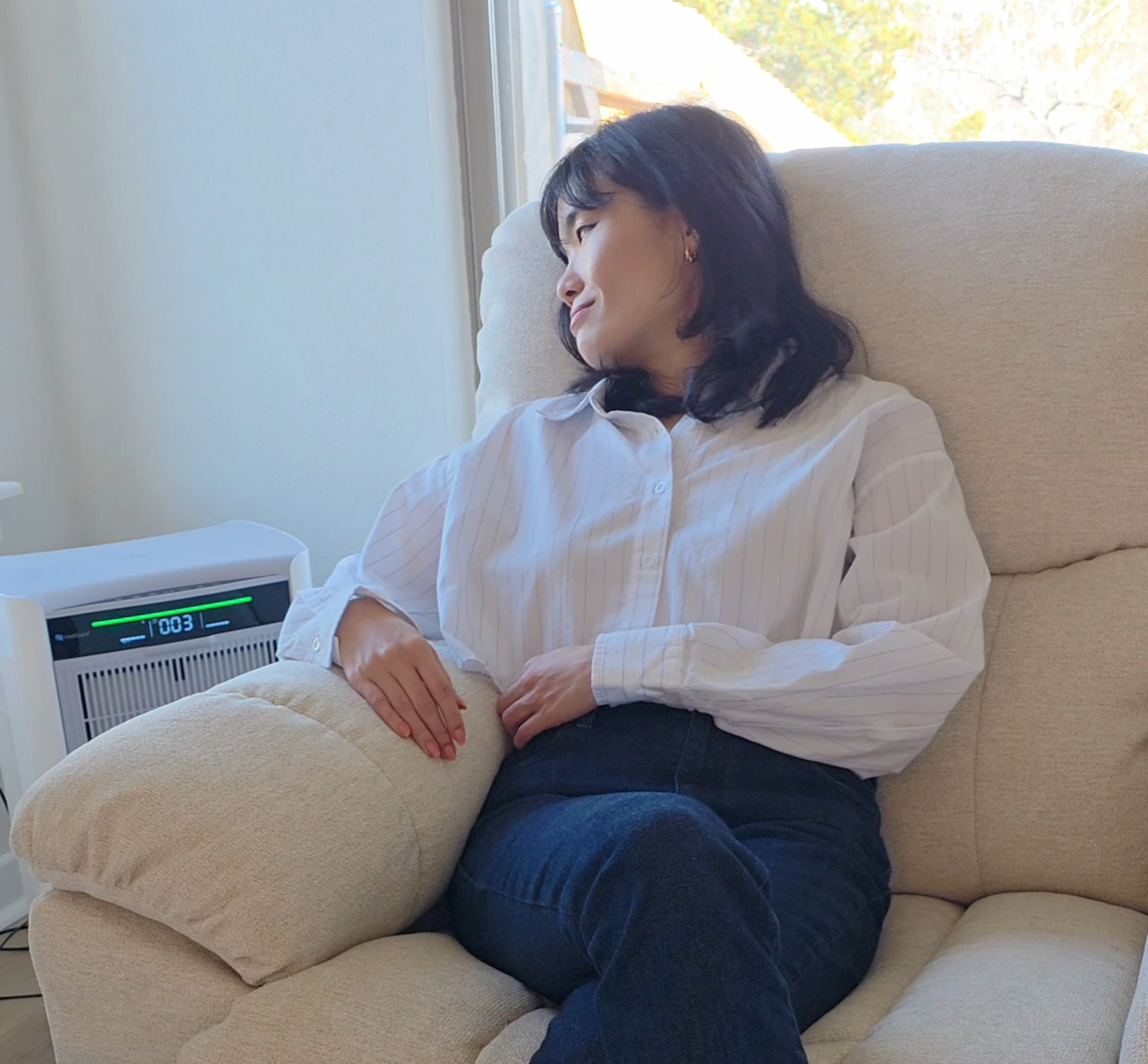
Pro tip: Get a great air purifier for indoor IAQ to really prime your air for breathing.
Take five. Try sitting or lying somewhere comfortable and following a guided slow-breathing exercise for at least five minutes. Choose a pace that feels controlled, not rushed. Then, do it again another day. The review did not identify one perfect method for everyone, which means consistency and good guidance may matter more than finding the trendiest technique. (AKA… find what works best for you.)
Breathing exercises for stress can also fit naturally into an evening routine. Dim the lights, step away from your phone, and give yourself five quiet minutes before bed. It's a small habit, but small habits are often the ones that actually stick.
Build a Better-Breathing Summer Routine
August wellness can be a little complicated. It's hot outside, indoor spaces can feel closed up, and even a simple errand can leave you overheated and overstimulated. I'd consider myself an active person, and I can barely cross a parking lot in this summer heat, so there's no judgement here.
Thermal comfort was one of the indoor environmental factors associated with lower workplace stress in the Singapore study [1][1]. Personally, I didn't need a study to tell me that being too hot or too cold for too long can drive a person crazy. Still, as many office workers know, that doesn't mean there's one perfect indoor temperature for everyone (shoutout to the sweater some of you keep at your desk). But it does suggest that physical comfort is worth considering alongside the rest of your environment.
A practical clean air wellness routine might look like this:
- Pay attention when a room feels stale or uncomfortable.
- Reduce obvious pollutant sources when you can.
- Keep sleeping and living spaces at a comfortable temperature.
- Make time for at least five minutes of guided, regulated breathing.
- Most importantly, repeat the habits that help instead of waiting for the next full wellness reset.
Cleaner-air habits and breathing exercises serve different purposes, but they can work together. One supports the space around you. The other helps you slow down inside it.
Make Room for Better Breathing
Self-care isn't only what you do. It's also the environment you create around yourself while you do it.
A calmer room, a more comfortable temperature, better awareness of VOCs and odors, a few minutes of intentional breathing, and a really good air purifier can all become part of a more thoughtful approach to wellness. None of these habits needs to be dramatic to make your home feel more supportive.
This National Wellness Month, start with something simple: Make room for better breathing. Clean air self-care may be one of the easiest habits you ever bring home.
References
- Thach TQ, Mahirah D, Sauter C, Roberts AC, Dunleavy G, Nazeha N, Rykov Y, Zhang Y, Christopoulos GI, Soh CK, Car J. Associations of perceived indoor environmental quality with stress in the workplace. Indoor air. 2020;30(6):1166-1177. doi:10.1111/ina.12696.
- Kim S, Gurmu BL, Kim M, Song C, Lee MR, Lim CC, Rule AM, Yang KI. Effect of indoor air quality on potential risk of obstructive sleep apnea: results from Korea National Health and Nutrition Examination Survey. BMC public health. 2025;25(1):1306. doi:10.1186/s12889-025-22127-2.
- Bentley TGK, D'Andrea-Penna G, Rakic M, Arce N, LaFaille M, Berman R, Cooley K, Sprimont P. Breathing Practices for Stress and Anxiety Reduction: Conceptual Framework of Implementation Guidelines Based on a Systematic Review of the Published Literature. Brain sciences. 2023;13(12). doi:10.3390/brainsci13121612.








Outside In: How Your Yard Affects Your Indoor Air Quality
Hurricane Season Starts Outside. The Air Prep Starts at Home.